Research
The Ultrafast Quantum Dynamics Group studies how electrons move in molecules and materials on femtosecond and attosecond time scales, and how light generated in these interactions acquires quantum properties. Electron motion on these time scales determines the outcome of chemical reactions, governs the response of materials to strong fields, and sets the ultimate speed limits of electronics. When ultrafast laser pulses drive a nonlinear optical interaction in a molecule or a solid, new light is emitted that carries detailed information about the underlying electron dynamics. We measure the complete electric field of this emitted light and, beyond that, its full quantum state. These classical and quantum field observables reveal dynamics that conventional intensity measurements cannot access. Our work spans ultrafast molecular physics, strong-field physics in solids, and the emerging area of attosecond quantum optics.
Our research is organized around four questions.
How do electrons in molecules move and lose their quantum coherence?
Photoexcited molecules evolve through coupled electronic and nuclear dynamics. At conical intersections, where electronic states approach degeneracy, electronic coherences are created and destroyed within femtoseconds. These processes determine the outcomes of photochemical reactions and set fundamental limits on charge migration in molecules. We probe them with electric field observables. In four-wave mixing, three femtosecond pulses interact with a molecule and a fourth signal field is emitted. We measure the amplitude and phase of this ultraweak signal field with spectral interferometry, which gives direct access to the induced nonlinear polarization and its dephasing [Walz et al., Opt. Express 30, 36065 (2022), Editor's Pick].
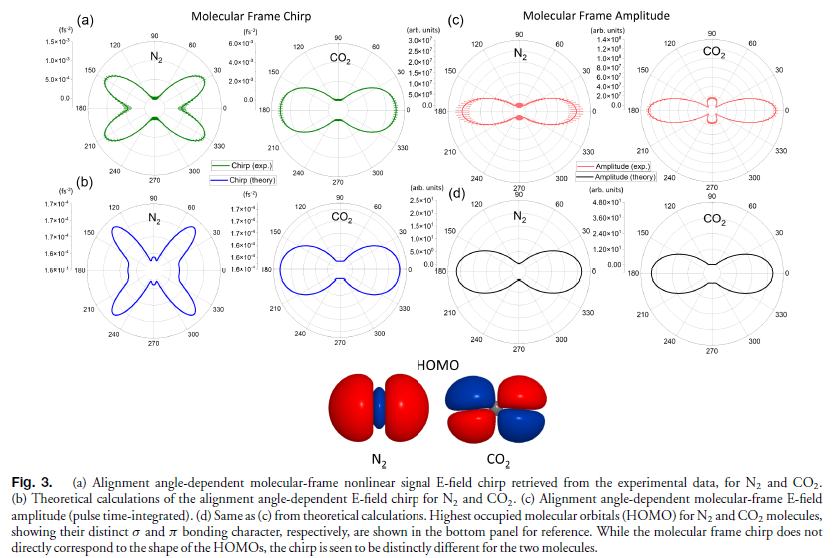
By impulsively aligning molecules with femtosecond pulses, we measure the nonlinear response in the molecular frame and track the evolution of electronic symmetries [Pandey et al., Optica 11, 776 (2024)]. We developed lock-in enabled phase tracking to stabilize these interferometric measurements [Pandey et al., arXiv:2503.05986]. On the theory side, we showed that transient absorption of aligned molecules gives access to molecular axis distribution moments and opens a path toward ultrafast quantum state tomography [Kumar et al., J. Chem. Phys. 163, 154301 (2025)]. We use femtosecond vacuum-ultraviolet pulses from high harmonic generation to excite molecules to valence excited states and follow the subsequent dynamics [Liu et al., arXiv:2610.00565]. Femtosecond VUV transient absorption spectroscopy below 10 eV in gas-phase molecules is a capability unique to our laboratory. Current experiments target electronic coherence dynamics at conical intersections and charge migration in molecules on attosecond time scales.
How does a strong laser field reshape a solid within one optical cycle?
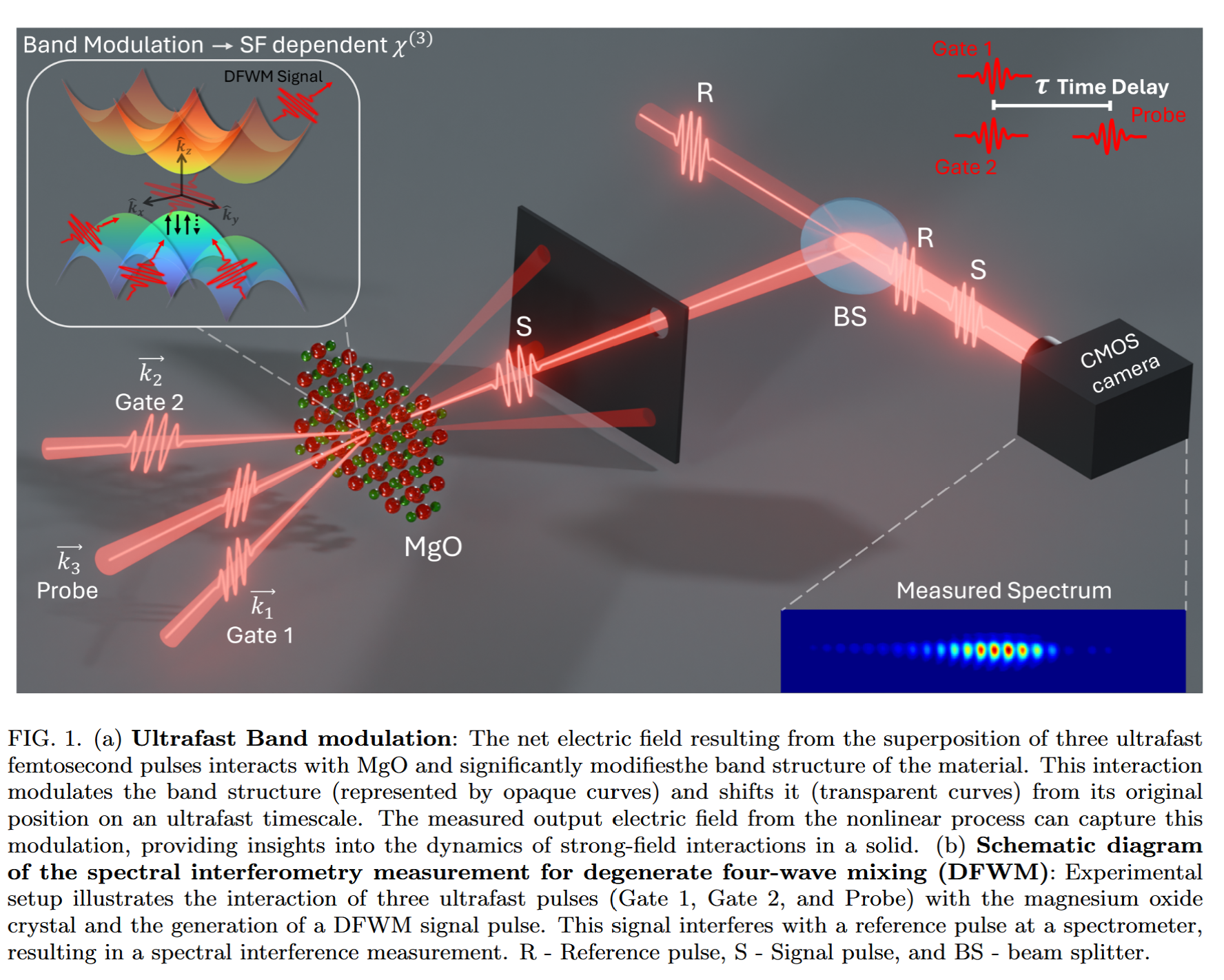
A strong femtosecond laser field drives electrons in a solid far from equilibrium and can transiently modify the band structure itself. Understanding and controlling this sub-cycle response is central to lightwave electronics, where optical fields would switch electronic signals at petahertz rates. We apply electric field observables to this problem. In magnesium oxide, we measured strong-field driven sub-cycle modulation of the band structure and showed control over dephasing of the induced nonlinear polarization, resolved through the electric field of a four-wave mixing signal [Walz et al., Science Advances 12, eaeg3966 (2026)]. We are extending this approach to two-dimensional materials such as hexagonal boron nitride and to correlated quantum materials, where field observables can expose interactions that are hidden from intensity measurements.
What is the quantum state of light generated in ultrafast strong-field interactions?
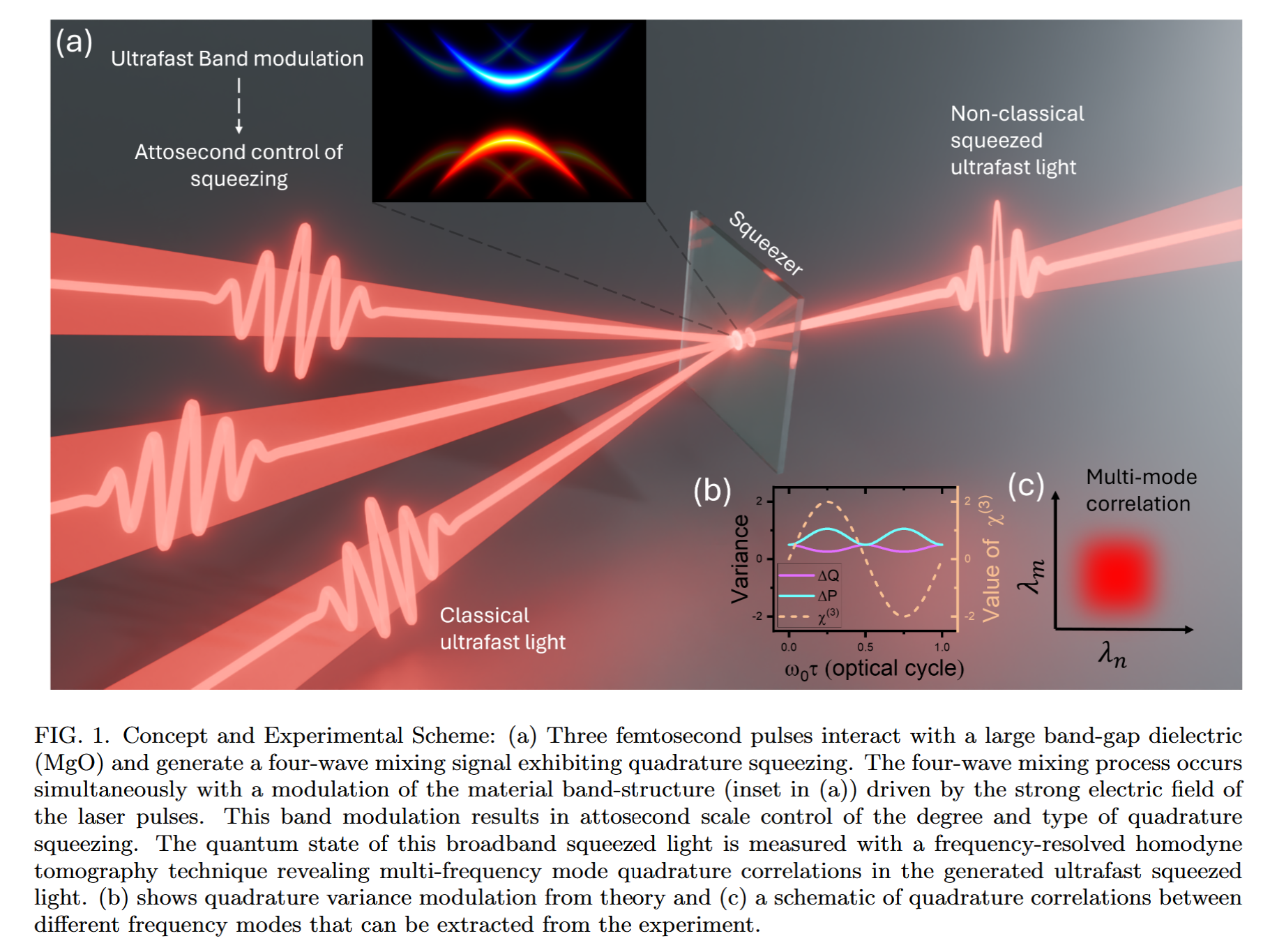
Every nonlinear interaction that generates new light also shapes the quantum state of that light. Strong-field driven nonlinear processes can produce squeezed light, which has noise below the shot-noise limit in one field quadrature, on femtosecond and attosecond time scales. Measuring such states requires quantum optical techniques adapted to broadband ultrafast pulses. We developed frequency-resolved balanced homodyne detection with nonlinear response modulation (NRM) filtering to perform complete quantum state tomography of ultrafast light. With this approach, we generated squeezed light through four-wave mixing in a strong-field modified solid and showed attosecond control of the degree and phase of squeezing [Zimmerman et al., arXiv:2512.17046]. We also measured quantum covariances between frequency modes at the shot-noise limit. A major direction of the group is to develop such quantum field observables for ultrafast spectroscopy, where the quantum statistics of light emitted by molecules and materials report on electronic coherences and correlations that classical field measurements cannot reach.
Can entangled photons deliver attosecond time resolution?
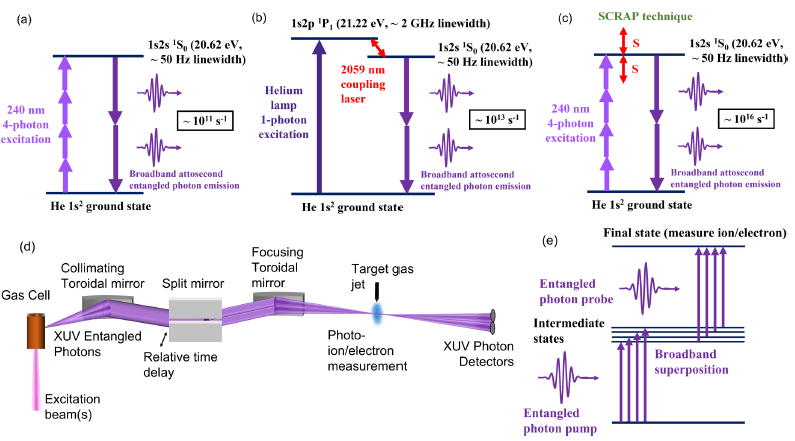
Entangled photon pairs in the extreme-ultraviolet carry arrival-time correlations on attosecond scales. Two-photon decay of metastable helium atoms emits photon pairs with an entanglement time near 200 attoseconds. Helium-like ions such as Ne⁸⁺ extend this to a few attoseconds in the soft X-ray region. In collaboration with Prof. Chris Greene, we proposed this biphoton source and a path to attosecond quantum spectroscopy, where quantum correlations rather than pulse duration set the time resolution [Wang et al., Phys. Rev. Res. 4, L032038 (2022)]. We then showed that broadband femtosecond pulses can efficiently drive two-photon excitation of the ultranarrow 1s2s singlet state in helium, a key step toward a bright source [Kumar et al., Phys. Rev. Res. 8, 013009 (2026)]. We are now building the experiment to generate these attosecond entangled photons and apply them in pump-probe measurements. This project is supported by a grant from the W. M. Keck Foundation.
Experimental capabilities
- Amplified titanium sapphire femtosecond laser system with a wavelength-tunable optical parametric amplifier
- High harmonic generation beamline producing femtosecond VUV and XUV pulses
- Femtosecond VUV transient absorption spectroscopy below 10 eV in gas-phase molecules
- Electric field measurement of ultraweak nonlinear optical signals with attosecond timing precision
- Frequency-resolved balanced homodyne detection for quantum state tomography of ultrafast light
- Velocity map imaging photoelectron spectrometer
- Hollow-core fiber pulse compressor for few-cycle pulses (coming soon)
Our research is supported by the U.S. Department of Energy Office of Science (Atomic, Molecular and Optical Sciences program), the National Science Foundation, the W. M. Keck Foundation, and Cortex Fusion Systems.